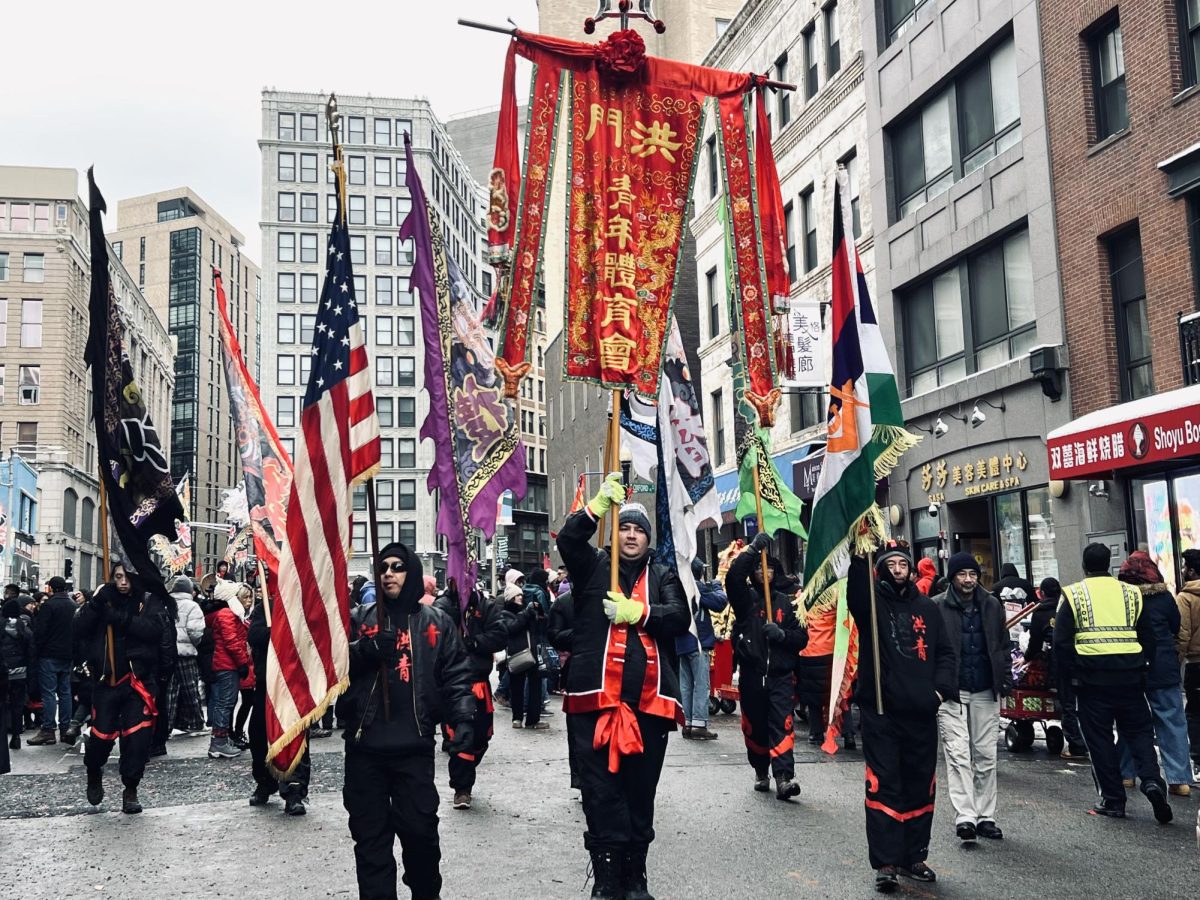
Wah May, a lion dance team based at the Asian American Cultural Center, has been working to preserve and promote the culture of the lion dance, blending performance, athleticism, and cultural storytelling.
As a nonprofit organization, Wah May trains individuals in lion dance, Kung Fu, and Qi Gong and engages in performances, competitions, and community events. Traditionally performed at New Year celebrations, weddings, and business openings, the lion dance symbolizes good fortune and the warding off evil spirits.
However, with younger generations shifting interests and cultural ties evolving, Wah May faces the challenge of keeping the tradition alive while making it relevant in today’s world.
Background of Lion Dance and Kung Fu Foundation
Originating in China, lion dance is commonly performed during celebrations such as New Year, weddings, and grand openings to bring good fortune and ward off evil spirits. However, beyond its festive appearance lies a foundation in Kung Fu, where every stance and step stems from martial training.
“For many Chinese born in the 1980s and ’90s, the first thing that comes to mind when discussing lion dance is the martial arts movie Once Upon a Time in China III, featuring Jet Li as Chinese martial arts master and folk hero Wong Fei-hung,” according to China Daily. “In the film, Wong travels to Beijing to compete in a lion dance competition, highlighting the deep-rooted link between lion dancing and traditional Kung Fu.”
In Boston, the Wah May Lion Dance Team is actively preserving this tradition. Based at the Asian American Cultural Center, the team integrates martial arts principles into every aspect of its training.
“We always teach all of our members the basics first — horse stance, bow stance, and fundamental Kung Fu principles,” said Lien Vo, one of the team’s organizers. She explained that newcomers begin with these forms before progressing to lion dance, as the performance draws heavily from Kung Fu.
For performers like Matthew Xu, the Kung Fu foundation is more than technical training—it is grounded in discipline, respect, and a strong command of fundamentals.
When describing the role of discipline, Xu emphasizes the mental resilience required to meet the physical demands of each routine. “If I can’t land a trick or synchronize with the instruments, I feel that I should continue to practice and not let failure stop me,” he said.
Respect is also central to the practice. Xu adds that dancers are taught to care for the lion costume, the instruments, their teammates, and the audience. “Getting the opportunity to perform is a privilege, so I also feel a sense of respect for the audience,” he said.
In addition, Xu highlights the importance of building a strong technical foundation through mastery of stances, movement patterns, and rhythmic coordination. “Having a strong basis of the fundamentals will really get you far in lion dance,” he said.
Kevin Nguyen, who started Kung Fu at 11 before transitioning to lion dance at 13, also sees this martial arts foundation as critical. “My sifu (A master or teacher in the context of martial arts) just knew the basics. But when my friends and I hit high school, we modernized it. We started to study like how other teams were doing it across the world,” he said.
Innovations in Lion Head Crafting
Nguyen is also a craftsman working to preserve and modernize the art of lion head making. Without formal training, he taught himself the techniques of building and restoring lion heads, an increasingly rare skill in the U.S.
“I learned it from myself and YouTube,” Nguyen said. “Eventually, I learned how to fix the lion heads, and from learning how to fix them, I just thought I wanted to learn how to make them. So I’ve been teaching myself how to make them.”
Traditionally, lion heads are constructed using bamboo frames and paper glue, but Nguyen has been experimenting with modern materials to improve durability and ease of use.
“So far, it’s all aluminum. I’m testing it out with steel, bending steel like how we bend bamboo is very hard. So I’m trying to find a lighter metal that I could find, a more malleable metal. But it’s like I’m making that thing just because my sifu always made fun of us for saying how heavy the lions were,” he explained.
His approach blends time-honored craftsmanship with innovative techniques, ensuring that lion heads maintain their cultural authenticity while adapting to the needs of today’s performers.
Beyond innovation, Nguyen sees lion dance as a form of storytelling shaped by his personal experiences and creative background. “I am an artist and I want to tell a story. I want to like give lion dance new stories rather than like trying to amplify just the traditional voices.”
While he respects tradition, Nguyen is more interested in “all the new stuff that could be explored with my dance.” For him, innovation is not about rejecting the past, but about creating new expressions that reflect both his roots and the dynamic, evolving world around him.
Challenges in Recruitment
While Nguyen innovates in craftsmanship, Vo focuses on keeping the Wah May team alive and thriving. She has prioritized recruitment and outreach, as many longtime members are stepping away.
“Our main focus as a team is really on growth,” Vo said. “A lot of our members have been with us for more than 10 years, and we haven’t seen a lot of growth in terms of newer members. So we have a lot of people who are aging out or because of life circumstances, they’re just not into lion dancing anymore. They’ve gotten too busy.”
As a nonprofit that offers free classes, Wah May is open to anyone interested in learning, but outreach remains a challenge. “We’re not in a centralized location, so it’s really hard for us to get the word out there for parents and for even college students who are interested,” Vo explained. To address this, the team is working on transportation solutions and considering relocating closer to the city to improve accessibility.
Despite their efforts, Vo notes that lion dance in the U.S. faces significant differences from its development in Asia, where professional teams have institutional and financial support. In contrast, American teams rely heavily on volunteers and private event bookings, making long-term sustainability difficult.
“I wish it could have a little more elevation, have a little more coverage, and really have more support overall in terms of whether it’s grants, funding, because right now, a lot of the time, a lot of the clubs, they’re really dependent on private events,” she said. With limited funding and sponsorship opportunities, lion dance teams are often forced to compete for gigs, which can make survival difficult.
Jung Chen Kuo, another team member, believes that one core challenge lies not just in the lack of resources but also in how lion dance defines itself in the American context.
“Consider Olympic gymnastics and Cirque du Soleil; one is competitive and the other is a performance piece,” he said. “Both exist in their own spheres and both are widely known exhibitions of gymnastics. The martial arts and lion dancing community should analyze the identity of lion dancing through that lens. Is it a performance piece intended to draw audiences and make them go “wow”? Or is it a competitive sporting event meant to showcase the best practitioners?”
Without a clear and shared identity, lion dance struggles to find its place and support within a system that favors easily classified disciplines. Vo builds on this idea, pointing out how the lack of a unified identity directly impacts how resources are distributed and how teams interact.
“It shouldn’t be such a competitive business model. It should be where it’s more collaborative, where everyone can coexist and find that middle ground of funding versus having fun versus providing a service to the community,” Vo said.
Even in the face of these challenges, Wah May is determined to push the art forward—through modernized training, competitive performances, and creative craftsmanship. As Vo puts it, “We’re an actual sport. We’re athletes. And when people look at us, they don’t say dragon dance, they call us a lion dance.”