
OpenClaw, a personal AI agent with the promise to be an “AI that actually does things”, is gaining unexpected popularity in China. Across the country, fans have likened the deployment to “raising lobsters,” a pun based on OpenClaw’s red lobster logo. Testers are hoping autonomous AI agents can power a new wave of small-scale digital entrepreneurship.
Some entrepreneurs are experimenting with a “company of one” powered entirely by AI and OpenClaw. Their business has no employees, no office space and not even a human resources department —instead, it is operated by a network of AI agents — managing operations, customer service, technical support, sales and system maintenance.
According to cybersecurity firm SecurityScorecard, China has become the country with the largest number of OpenClaw deployments in the world — nearly double that of the United States.
“China’s market is especially vulnerable here because the competitive intensity means people ship first and fix later — the whole culture of “先上线再说” (get it online first, figure it out later) accelerates deployment but also accelerates risk,” said Afra Wang, who writes Concurrent, a newsletter about Silicon Valley, China and AI.
OpenClaw, formerly known as Clawdbot and Moltbot, was developed by Austrian programmer Peter Steinberger, who decided to join OpenAI last month. It has since surpassed 300,000 stars on GitHub, making it one of the platform’s most popular projects. Speaking at a conference hosted by Morgan Stanley, Jensen Huang, the CEO of Nvidia, described OpenClaw as the “most important” software release of our time.
It’s different than generative chatbots that help users think through questions and provide answers because it can execute tasks directly on behalf of users on their local computer.
In China, consumers are looking for ways to use it as a workhorse capable of doing many tasks. It’s used for everything from automated replies, industry monitoring, video editing, product sourcing for cross-border trade, to other tasks.
A Nationwide Frenzy
Last week, Tencent hosted a free in-person OpenClaw installation workshop at its headquarters in Shenzhen, a technology hub in southern China. Tencent claimed the event helped hundreds of users install the tool on Tencent Cloud.

“I received a video notification about the event from Tencent Cloud about 28 hours beforehand. At the time, it had only a few dozen reposts and likes, so I didn’t expect so many people to show up,” said Alex Li, who joined the workshop last Friday. His comments were translated from Chinese to English. “I waited in line for about three hours. The installation itself only took a few minutes, but the one-on-one Q&A took much longer. People were eager for the opportunity to talk with Tencent engineers.”
While the internet is filled with complicated installation tutorials — often challenging for non-technical users — Tencent says its QQ Open Platform can integrate seamlessly with OpenClaw, and the agent center in QQ Browser allows users to deploy the tool with a single click. Tech company Baidu Intelligent Cloud is also moving to lower the deployment bar by introducing DuClaw, a zero-deployment service to simplify adoption.
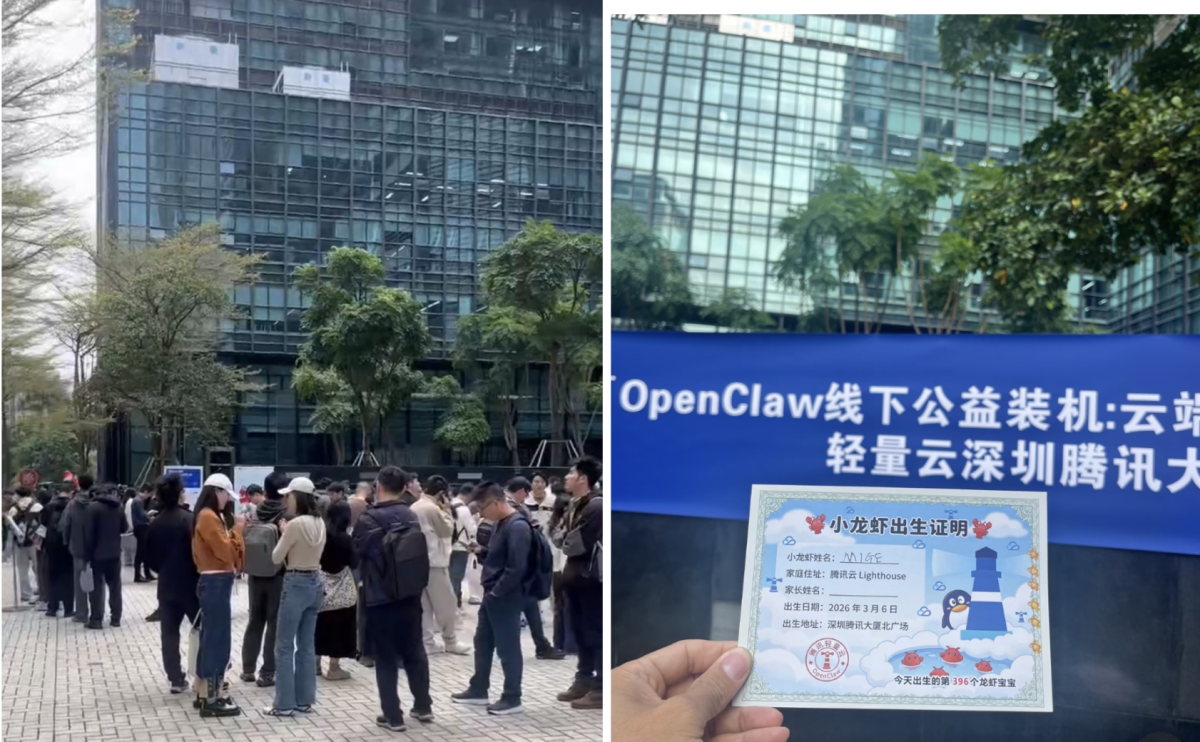
“I talked with people waiting in the line,” Li said. “They came from a wide range of industries—from Tencent employees to people working in the new-energy sector, a retired finance teacher, entrepreneurs like me running one-person companies, and creators producing short-form animated videos at MCN agencies.”
One Person Company, or OPC, refers to a lightweight entrepreneurial model led by a single founder rather than a full team. The concept has recently been gaining momentum in China.
Li, who runs a freestyle twin-tip skiing brand, has been exploring how OpenClaw could help reduce costs for his one-person business. “My business used to spend a lot on personnel,” he said. “With more AI companies emerging in Shenzhen — a place that’s highly sensitive to tech trends and where new ideas spread quickly — I wonder whether a one-person company might not even need office space anymore.”
Sherry Wang, a data application scientist at Microsoft China, is actively collecting potential user application scenarios from social media. “One of the simplest and easiest to practice we’ve seen is using OpenClaw to identify potential clients,” she said. “For example, exhibition organizers may need to find target companies for an event, or investors might want to search online for promising projects. When the tasks need relatively low-skill operations, automation can be very effective.” Her remarks were also translated from Chinese.
In Beijing, because the AI events were fully booked due to overwhelming demand, Sherry Wang decided to organize her own offline “lobster monetization” salon and invited “veteran lobsters breeder” to speak on project landing plans.
“Retail investors are driven by FOMO and curiosity — the same dynamic I saw when I attended a Peking University AI course in Shanghai filled with mid-career founders from completely unrelated industries: a generator factory owner from Wuhan, a rice seller from Dongbei, an aquarium operator. None of them could articulate a concrete AI use case. They were there anyway.” Afra Wang shared.
“That FOMO is distinctly Chinese,” Afra Wang said. “I genuinely couldn’t picture its American equivalent, a dinner where an Iowa corn farmer and an Atlanta aquarium director sit down together for a six-week AI course at Stanford.”
Subsidy Wars
Despite warnings from Chinese national media about the potential security risks of OpenClaw, local government authorities have recently encouraged companies to build applications using the AI tool.
The Local government in Shenzhen’s Longgang district is offering policy support — equity financing of up to 10 million yuan (about $1.46 million) for one-person companies using OpenClaw. The city of Wuxi’s draft policy offers up to 6 million yuan (about $830k) in support for selected OPC projects.
Government policies also provide support for the computing power, data and hardware required for “lobster-raising.” At least four cities launched financially supportive measures for OpenClaw adoption.
“Local officials are racing to be the district that claims credit for nurturing the next wave,” Afra Wang explained. “In China’s system, companies essentially become ‘assets’ of their host cities, and local governments compete fiercely for talent, investment, and the prestige of hosting the next big thing. ”
China’s AI boom is shaped by a top-down policy push that has sparked competition among local governments. The latest State Council Work Report pushed artificial intelligence as a priority, urging wider commercialization and large-scale applications in key sectors. Top AI hubs are taking different paths to develop the industry in their local government work report: Beijing emphasizes research leadership, Shanghai capital and infrastructure, Shenzhen full-stack autonomous & controllable technology, and Hangzhou private-sector–driven innovation.
Afra Wang expressed concerns as cities compete to position themselves at the forefront, “Local governments often lack the technical sophistication to distinguish genuinely promising projects from AI-labeled gimmicks. I’ve seen this firsthand — visiting “AI towns” and innovation parks where products are essentially ordinary consumer electronics slapped with an AI label to satisfy policy directives and funding requirements. ”
The “lobster raising” craze is only a snapshot of a much larger AI wave sweeping China since the start of the year.
When the AI video-generation tool Seedance 2.0 debuted, users flocked to the platform to create their own “big-budget Hollywood film”. At the ByteDance sponsored Spring Festival Gala, which is the Chinese equivalent of the Super Bowl in terms of commercialization, interactions with the company’s Doubao AI reached 1.9 billion, as the audience used it to generate Lunar New Year–themed profile pictures and holiday greetings at no cost.
“In America, AI optimism is confined almost entirely to Silicon Valley,” said Afra Wang. “And even there it takes a cultishly bullish form that fails to persuade the rest of the country. In China, the government, the tech industry, and the general public are broadly synchronized in their enthusiasm. This isn’t just propaganda — decades of lived experience have taught Chinese society that technology makes life tangibly better.” Afra Wang shared a story about her grandmother, who once walked five hours to buy a clock to get her child to school on time.
“Today delivery drones fly above her apartment. AI simply looks like the next turn of a wheel that has only ever spun forward,” she said.
There are signs on social media that the “lobster-raising” craze is now cooling down. “The first wave of users uninstalling OpenClaw” has become a trending topic. A programmer on Xiaohongshu, a Chinese app similar to Instagram, which is at the epicenter of the online frenzy, warned of macOS-targeted malware found in the ClawHub skills library. Others are seeking advice on how to fully remove the tool.
After experimenting with OpenClaw herself, Sherry Wang said the technology still needs time to prove its real-world value. “For now, I think this is a tool mainly for people who enjoy exploring new technologies,” she said. “What kind of practical impact it can have in everyday life is something we may only understand after a few more months of experiment.”
*Note: This article has been updated on March 15 with additional information.