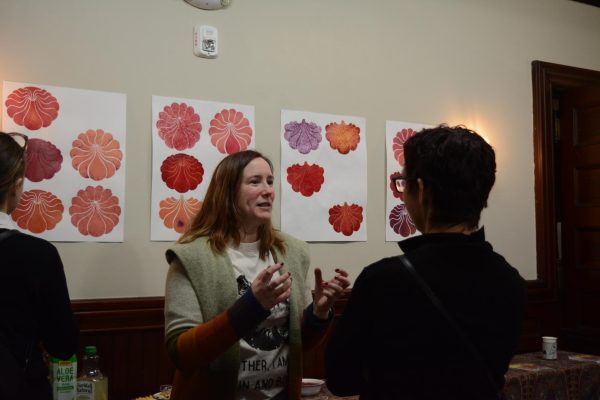
On January 17, a Saturday, at Providence, the first floor of the International House of Rhode Island was unusually full. Audience members, artists, tutors, volunteers, and Providence residents sat together, “testing” a form of health self-examination.
The speakers hang a large, brightly colored scarf around the neck. Woven into its surface were images of trees and birds, surrounded by dotted pathways, which traced the directions of breast and chest self-examination. Instead of diagrams or written instructions, the vivid icons and clear dots transformed what is often a clinical lesson into something tactile and legible.
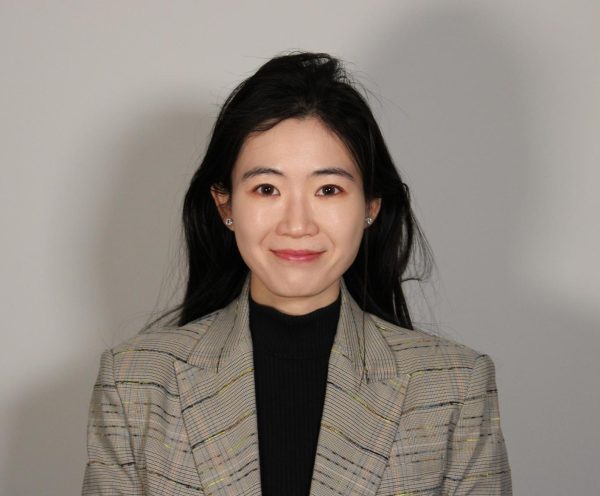
The event was actually a lecture and ephemeral exhibit titled Tree of Life for Breast/Chest Health, presented by the artist Eliza Squibb and Jiayue Zhang, a Ph.D. student at Brown University. They work with Higher Ground International, a non-profit organization based in Providence that offers support to marginalized groups, to design health communication that can break down language and literacy barriers.
The event was not an outlier. It was one example of how the International House of Rhode Island operates: through lectures, classes, and gatherings shaped by people who move fluidly between being learners, teachers, and community members.
Originally founded to support international students, IHRI has evolved into a broader community resource, serving immigrants, visiting scholars, spouses of students, retirees, and local residents interested in cross-cultural exchange. A bigger question is how we might revisit the organization’s role in supporting immigrants, especially in the current moment, when some migrants are experiencing heightened anxiety because of ICE crackdowns.
A Home Away From Home
For many first-time visitors, the impression is immediate. The building feels more like a home.
Founded in 1963, the International House of Rhode Island (IHRI) is among the oldest migrant- and language-focused community organizations in the state. It serves more than 1,000 people from over 70 countries in a typical year, including Turkey, Russia, Colombia, China, and so on. The organization operates with a small staff and around 60 volunteers, who make its daily activities possible.
For Heidi LaVine, the executive director of IHRI, this place has been not primarily as a service provider, but as a space built around “mutual give and take,” she said.
That philosophy shapes how programs are designed. Rather than relying on a fixed curriculum, IHRI’s classes are conversation-based and flexible. Group classes emphasize speaking and confidence, especially for learners who understand English but struggle to use it in real-life situations.
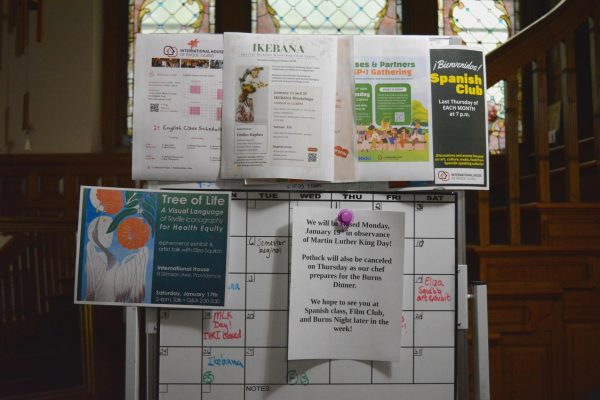
One-on-one tutoring is matched to individual goals, including preparing for graduate school, navigating conferences, or gaining the confidence to manage daily life independently. In some cases, tutors share a student’s native language, allowing explanation and reassurance when confusion arises.
As Heidi said to us, “Now, more than ever, we are acutely aware of how important these safe, welcoming spaces are, and we are so grateful to be connected to many community partners in Providence who are able to help our community with housing assistance, legal aid, legislative advocacy, and other forms of resource assistance that fall beyond our purview. ”
Built on Trust
At IHRI, there is no rigid boundary between educators and learners. Actually, many tutors are, or once were, students themselves.
Bob Vachon, a longtime tutor and former chair of the organization’s board of directors, began his career as a high school teacher and later a college professor. After retiring, he returned to teaching at the International House, drawn by the energy of working with people from different cultural backgrounds.
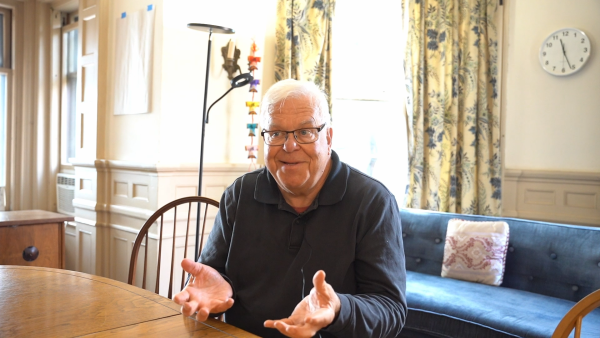
His approach is deliberately adaptive. Lessons are shaped around students’ interests and immediate challenges, from navigating grocery stores to preparing for conversations at work. But before instruction, Bob emphasizes something else: trust.
In his view, the foremost thing is to help students feel that they belong, so they are not afraid to make mistakes. That trust, he says, often turns language learning into something practical and relational, and sometimes extends beyond the classroom, as when he once helped a student learn how to drive in an empty parking lot.
Joe Scott, a retired French teacher, has been tutoring at IHRI for over a decade. His students range from recent art school graduates to a 93-year-old woman determined to retain her French. What keeps him engaged, he says, is the freedom to shape lessons around individual goals rather than a standardized curriculum. Each session begins with a simple question: what does the student want to accomplish today?
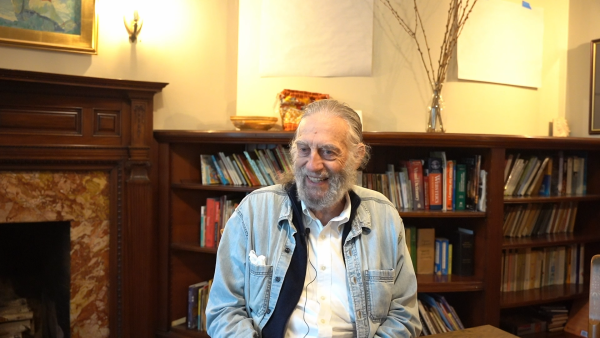
Heidi describes this dynamic as central to how the House functions. “Many tutors are retired professionals, including former teachers, social workers, journalists, and healthcare workers, who bring both time and experience.” What holds the system together is a shared understanding of purpose: Learning as mutual exchange rather than one-way instruction.
This informal system works, in part, because it was never designed as a top-down program. From its earliest days, the organization was built around a simple idea: helping first, structuring later.
The Legacy of a Family and a House
The sense that IHRI feels like a home is not accidental. Its origins lie in a domestic space.
The organization was founded by Gill and Billy Mason, a local couple deeply curious about the world and the people in it. In the early 1960s, before universities had formal support systems for international students, Billy Mason met a Japanese exchange student at Brown University who told her how lonely he felt. She invited him to dinner. He brought friends. What began in the Masons’ kitchen gradually grew into an institution.
The building that now houses IHRI, donated in the 1980s by Robert and Alice Rooke, at the request of their daughter Dorothy McCulloch, who is their long-time benefactor. Over the years, the House has faced financial strain, infrastructure costs, and the disruptions of the COVID-19 pandemic. At one point, the board debated whether to give up the building altogether. They chose to keep it because the physical space mattered: it allowed people from different countries to feel at home, not merely accommodated.
Today, the Mason family remains involved as supporters rather than managers, preserving a legacy centered on hospitality rather than oversight. That legacy is sustained not through formal programs alone, but through everyday interactions: shared meals, language lessons, cultural events, and quiet conversations at the front desk.
Every Thursday at noon, the building fills with voices from different countries as people gather for the weekly potluck. Gulai Ramos, originally from Turkey and a retired former embassy employee, discovered IHRI shortly after moving to Providence. She first joined as a learner, then gradually took over the weekly movie club, curating international films and facilitating post-screening discussions.
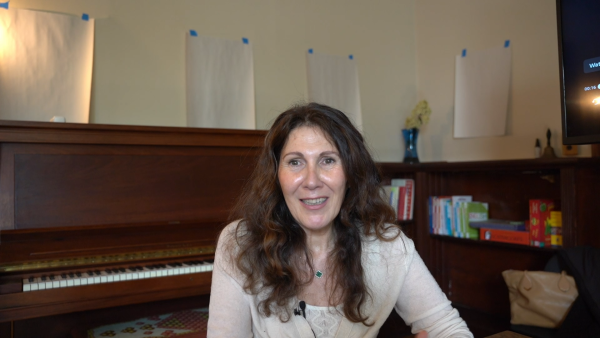
Hsin-Fang Chung began her journey at IHRI as an English learner after arriving in Rhode Island in late 2023. She describes IHRI as “a warm house,” a place where people build connections and share information across borders.
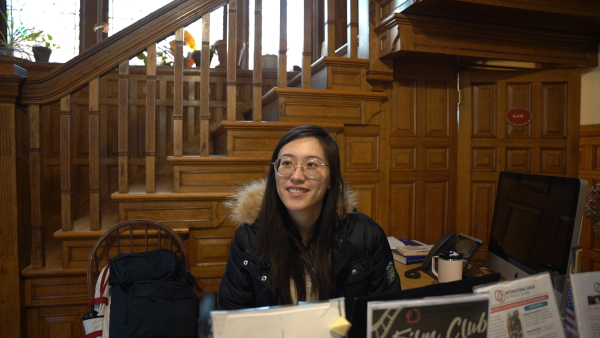
Across the organization, roles shift constantly: students become volunteers, volunteers become tutors, tutors return as learners in other classes. These transitions are not formally planned. They emerge naturally, shaped by trust, availability, and a shared willingness to give, which happens in a space where people are allowed to arrive, to change roles, and to belong, and sometimes all at once.